Do you suffer from headaches or do you know someone who does?
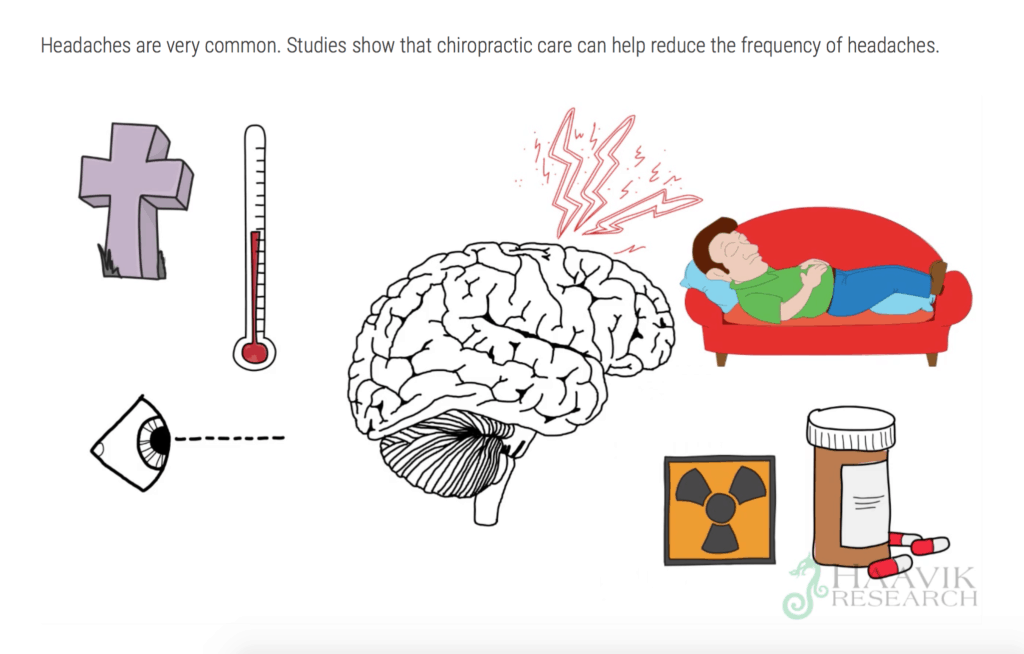
The head is the most common site of pain in the body. It may be throbbing, squeezing, constant, unrelenting or intermittent.
A headache, like any pain in the body, is a sign that something isn’t right.
Research has shown that chiropractic adjustments can help the brain to accurately see and feel what is going on in the body. This may help in the prevention of headaches.
Research
Results show that chiropractic care does help some people with headaches and migraines.
One study published in 2000 looked at 127 people suffering migraines (Tuchin et al. 2000). They compared two months of chiropractic with no care at all. After two months the chiropractic group improved with all outcomes.
1 in 5 people with migraines found that they nearly resolved completely.
Results of this study suggest that a large number of migraine sufferers may respond to chiropractic care.
Another study (Haas et al. 2010) was conducted in 2010 on “chronic cervicogenic headaches”, these are the tension type headaches that often present as a pain or tightness across the forehead or at the back of the head. The researchers compared 8 weeks of chiropractic (either once or twice a week) with 8 weeks of light massage. They looked at pain scales, frequency of headache and medication use.
The chiropractic care group improved significantly compared with the ‘control group’ receiving massage. All pain and disability scores improved and some pain scores even improved for 24 weeks until the last follow-up. The chiropractic group also used less medication. A small benefit was seen with increased frequency. The conclusion was that people are 3 times more likely to have a significant improvement in headache when using chiropractic as a treatment, compared with light massage.
Disclaimer: I still believe that massage is a great adjunct to chiropractic care and will continue my 4-6 weekly massages along with my monthly chiropractic adjustments!
Published research from the video:
Tuchin, Peter J. et al. A randomized controlled trial of chiropractic spinal manipulative therapy for migraine. Journal of Manipulative & Physiological Therapeutics , Volume 23 , Issue 2 , 91 – 95
Haas M, Spegman A, Peterson D, Aickin M, Vavrek D. Dose response and efficacy of spinal manipulation for chronic cervicogenic headache: a pilot randomization controlled trial. The Spine Journal2010;10:117–28
Imagine you’re sitting, scrolling through Facebook or your emails and someone lets a tiger into the room. What would you feel and what would you do? Naturally I would expect a few things such as:
A beating heart
A rush of adrenalin through your arms and legs (tingling, pulsing, shaking)
Increased breathing
Lack of focus
This is your “fight or flight” response. You’re either going to stay and wrestle the tiger to the ground. Or you’re going to run for your life. Either way you need your body to:
Open your blood vessels to provide more blood flow to your arms and legs so you have the strength to fight or run
Increase your heart rate so you can pump that blood around
Increase your blood pressure as the blood pumps around
Increase your breathing rate so you have enough oxygen for those muscles
Tighten and tense neck and shoulder muscles
At the same time your body stops or changes the balance of:
Immune system function – fighting off that virus someone has just coughed into the air is not as much of a threat to you as the tiger
Hormones – its not important to be making babies when there’s a tiger around
Digestion – Digesting food is not important when you’re about to be something else’s food
Sleep – it’s not safe to fall asleep otherwise the tiger will get you or your family
Everything is aimed at survival
This is driven, controlled and stimulated by the sympathetic nervous system.
These changes also happen in our everyday lives. It’s what helps to keep our body in balance. These changes happen when the boss puts pressure on our work output, when the kids test their boundaries, when we argue, whenever we feel pressure in life and believe it or not, the very action of sitting at a desk is actually a stress on our body.
To be fair to our sympathetic nervous system also helps out in positive situations. It helps us to keep our blood sugars in balance, our blood pressure even so we don’t get dizzy when we stand up, it dulls down loud noises and protects our eyes from bright lights. This also helps us to survive as these are vital functions for our body to maintain homeostasis (balance).
Perception of pressure is stress
Stress stimulates the ‘fight or flight’ mechanism in our body.
When these stressors continue our body spends more and more time in “fight or flight” until that is our new normal. We spend our lives on edge. Waiting for something to happen. This is sympathetic dominance and it begins to manifest in other ways:
Lower immunity – frequent colds and flus
Digestive system upsets – diarrhoea, constipation, gas, bloating, food intolerances
Hormone issues – irregular cycles, polycystic ovaries, infertility, heavy and painful periods, long or short cycles
Sympathetic dominance has far reaching effects on the body.
Screen time including ipads, mobile phones, laptop computers
Mental/Emotional
Unfulfilling relationships
Turning up to a job each day that we hate
Self-esteem issues
Unresolved childhood traumas
Biochemical/nutritional
Poor diet high in processed sugars and processed foods
Nutritional deficiencies such as zinc, magnesium and B vitamins
Toxins such as those in fast food, cosmetics and other personal care products, the environment or medications
Dehydration
So what can you do about this?
As I have explained in the Health Triad blog post, all health conditions are best approached from all sides of the triangle: physical/structural, mental/emotional and biochemical/nutritional.
Reducing physical and structural stressors using exercises to reverse poor posture, participating in light exercise rather than vigorous exercise everyday, stretches to counteract the negative effects of sitting at a desk all day and of course, chiropractic adjustments will all help to keep the body physically well.
Dealing with unresolved stress with methods such as meditation, NeuroEmotional Technique, taking time out for yourself each day, getting some sunshine, participating in hobbies you enjoy or spending time with friends are all good to reduce our mental/emotional stress.
Reducing the toxic load on our bodies through natural cleaning products, organic personal care products (don’t put anything on your skin you wouldn’t put in your mouth) and eating organic foods where possible will help with biochemical stress. Drinking plenty of water, which means 30mL per kilogram of body weight (1.8L for a 60kg person) each day helps to flush out toxins and keeps us feeling fresh. Plenty of fresh fruit, vegetables, nuts, seeds and well-sourced meats, rather than junky, processed packaged food which is full of chemicals is important to reduce biochemical and nutritional stress on our bodies.
I have just completed my Practitioner Certification in the SD Protocol. Please let me know if you have any more questions about sympathetic dominance.
Below is a video from Dr Wayne Todd, developer of the SD Protocol:
Have you experienced NET? Have you tried to explain it to a friend…”you hold your arm up and they say words and I don’t know, it just makes me feel better.“
Here is a great video explaining the concepts of NET. So if you’ve been wondering what it’s all about and how it works, or experienced the positive effects and would like to know more…take a look here!
Summary
Founded by Dr Scott Walker and co-deveoped by Dr Deb Walker
Taught for the first time in May 1988
There are currently over 8000 practitioner who use this technique
“NET is a tool that can help improve many behavioural and physical conditions using a methodology of finding and removing neurological imbalances, related to the physiology if unresolved stress.”
“Neuro-Emotional Complex: A subjective mal-adaption syndrome adopted by the human organism in response to a real or perceived threat.”
NEC’s are the patients emotional reality. Think about how you feel after a nightmare, you wake up with a racing heart, but the dream isn’t real. You are still having a physiological response.
After we process an emotional experience, its normal for the body to come back into balance. This does not always happen.
Muscles that are previously ‘strong’ will test weak when saying a non-congruent statement. This has been scientifically validated by Dr Daniel Monti.*
We are NOT talking to the body, asking the body questions or predicting the future!
Interexaminer Reliability Of The Deltoid And Psoas Muscle Test
Henry Pollard, DC, PhD, Bronwyn Lakay, MChiro, Frances Tucker, MChiro, Brett Watson, MChiro, and Peter Bablis, DC Journal of Manipulative and Physiological Therapeutics, 2005 Jan;28(1):52-6